
Grade 2 vs Grade 3 Faults Explained
Introduction
One of the biggest causes of confusion after a driving test is being told, “You failed due to a Grade 3 fault.”
Many learners believe they only made a small mistake. Others pass with several Grade 2 faults and are unsure why those mistakes were allowed.
The truth is, the same action can be Grade 2 or Grade 3 depending on the risk, safety, and outcome.
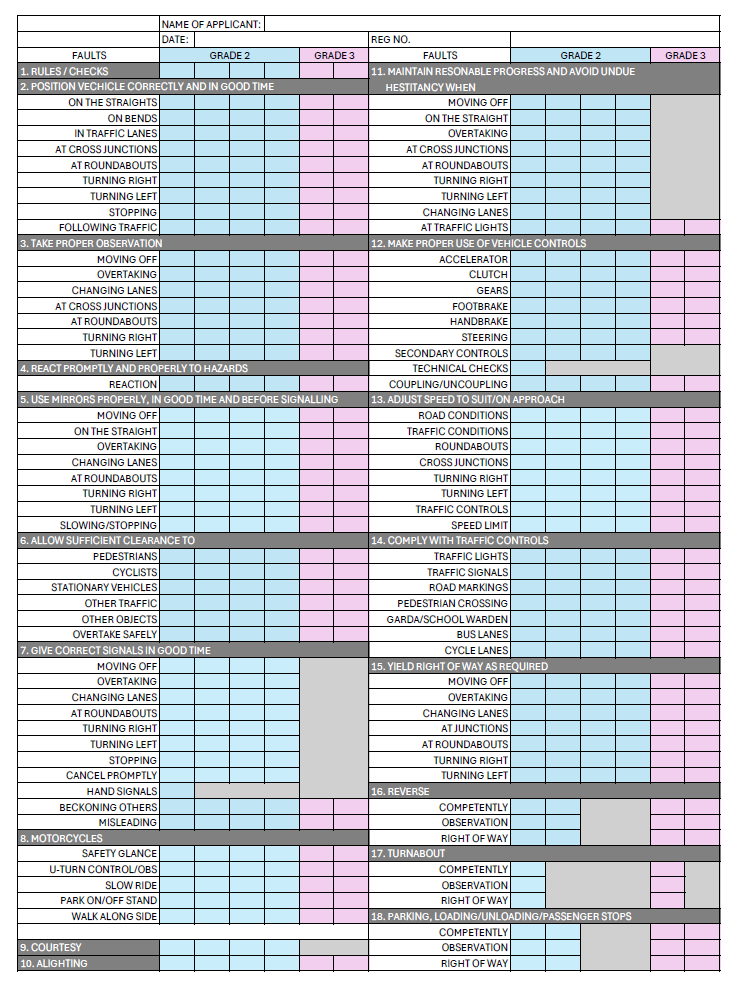
This guide explains Grade 2 and Grade 3 faults exactly as they are defined and applied by the Road Safety Authority, using the official 2025 examiner marking guidelines.
How the RSA Marks the Driving Test
During the test, the examiner records faults under specific marking headings, such as:
- Observation
- Anticipation and planning
- Reaction to hazards
- Speed control
- Positioning
- Control
- Compliance with traffic signs and rules
Each fault is graded by severity, not by nerves or confidence.
What Is a Grade 2 Fault (Minor Fault)?
A Grade 2 fault is recorded when:
- There is a lapse in driving performance
- Safety is not compromised
- Other road users are not affected
- The situation remains under control
Grade 2 faults indicate imperfect but safe driving.
What Is a Grade 3 Fault (Serious Fault)?
A Grade 3 fault is recorded when:
- Safety is compromised
- Another road user is affected (brakes, slows, changes direction)
- The candidate shows poor judgement
- There is a failure to comply with road rules in a dangerous way
One Grade 3 fault = automatic fail, regardless of how well the rest of the test goes.
Grade 2 vs Grade 3 by RSA Marking Category
Below are direct comparisons, using RSA categories and examiner logic.
Observation
Grade 2:
- Checks mirrors late but no danger arises
- Looks both ways at a junction but pauses slightly
- Misses a secondary mirror check with no impact
Grade 3:
- Fails to check properly before moving off
- Pulls out of a junction without adequate observation
- Does not observe pedestrians or approaching traffic
RSA focus: Did the lack of observation create risk or danger?
Anticipation and Planning
Grade 2:
- Slows slightly late for a developing hazard
- Hesitates but does not obstruct traffic
- Brakes sharply due to late planning but safely
Grade 3:
- Fails to anticipate hazards and causes danger
- Creates a situation where others must react
- Approaches hazards without adjusting speed or position
RSA focus: Was the situation allowed to develop into risk?
Reaction to Hazards
Grade 2:
- Responds late but safely
- Hesitates briefly before proceeding
Grade 3:
- Reacts too late and causes danger
- Forces another road user to brake or change direction
RSA focus: Was the reaction safe and timely?
Speed Control
Grade 2:
- Drives slightly below or above the ideal speed
- Inconsistent speed with no danger
Grade 3:
- Exceeds the speed limit
- Drives too fast for conditions
- Speed contributes to a dangerous situation
RSA focus: Was speed appropriate for safety, not just legality?
Postioning
Grade 2:
- Slightly poor lane position with no impact
- Leaves excessive clearance but remains safe
Grade 3:
- Incorrect positioning creates danger
- Fails to position correctly at junctions or roundabouts
- Unsafe clearance from parked vehicles or cyclists
RSA focus: Did positioning affect safety or other road users?
Control
Grade 2:
- Stalls once and recovers safely
- Minor clutch or brake control issues
Grade 3:
- Mounts the kerb
- Loses control of the vehicle
- Rolls back significantly and creates danger
RSA focus: Was control maintained at all times?
Compliance with Traffic Signals and Controls
Grade 2:
- Slight hesitation at signs
- Minor positioning errors near signs
Grade 3:
- Fails to obey a stop sign
- Drives through a red light
- Ignores mandatory road markings
RSA focus: Was a mandatory instruction ignored?
How many grade two faults are allowed? (Official RSA rules)
Under the RSA Marking Guidelines 2025, a candidate fails if they receive:
- 9 or more Grade 2 faults overall
- 4 of the same Grade 2 fault under one specific aspect
- 6 or more Grade 2 faults under the same marking heading
- Any Grade 3 fault
Maximum Grade 2 faults allowed overall: 8.
Why Learners fail with 'only small mistakes'
Because patterns matter.
Repeated Grade 2 faults show:
- Weakness in a core skill
- Lack of consistency
- Reduced overall driving competence
The RSA marking system rewards safe, consistent driving, not occasional brilliance.
Key takeaway for learner drivers
- You do not fail for being nervous.
- You fail for risk, danger, or repeated weakness.
Understanding how Grade 2 faults become Grade 3 faults helps learners focus on safety and judgement rather than perfection.