
Driving Test Nerves: How to Stay Calm Before Your Driving Test
You can drive perfectly well during lessons. You know your manoeuvres, your observations are good, and your instructor believes you're ready.
Then somebody mentions the driving test, and suddenly everything changes.
Your heart starts beating faster. Your hands feel clammy. You begin questioning things you've done hundreds of times correctly before.
Driving test nerves are incredibly common. In fact, a certain amount of nervousness isn't necessarily a bad thing. It shows that the test matters to you and can actually make you more alert.
The problem comes when those nerves begin interfering with the driving skills you already have.
So rather than simply telling yourself to "calm down", it can be useful to have a few practical techniques you can turn to before your test.
Two you may come across are box breathing and Thought Field Therapy (TFT). They are quite different techniques, and the scientific evidence behind them isn't equal, but both are worth understanding.
Why Do We Get So Nervous Before a Driving Test?
A driving test is an unusual situation.
You are sitting beside somebody you've probably never met before, knowing they're watching and assessing your driving. You've also invested considerable time and money getting to this point.
Your brain understandably decides:
This is important.
That can trigger the body's stress response. Your heart rate increases, breathing can become quicker and shallower and your muscles tense.
For a learner driver, that can lead to other problems.
You might grip the steering wheel too tightly, rush something you'd normally take your time over, hesitate unnecessarily or start analysing every little decision.
I've written previously about overthinking while driving, because this is something I see regularly with learners. When we're under pressure, we can start consciously questioning skills that have already become quite natural.
The aim therefore isn't necessarily to eliminate every nerve.
It's to stop those nerves taking over.
Box Breathing: A Simple Technique for Driving Test Nerves
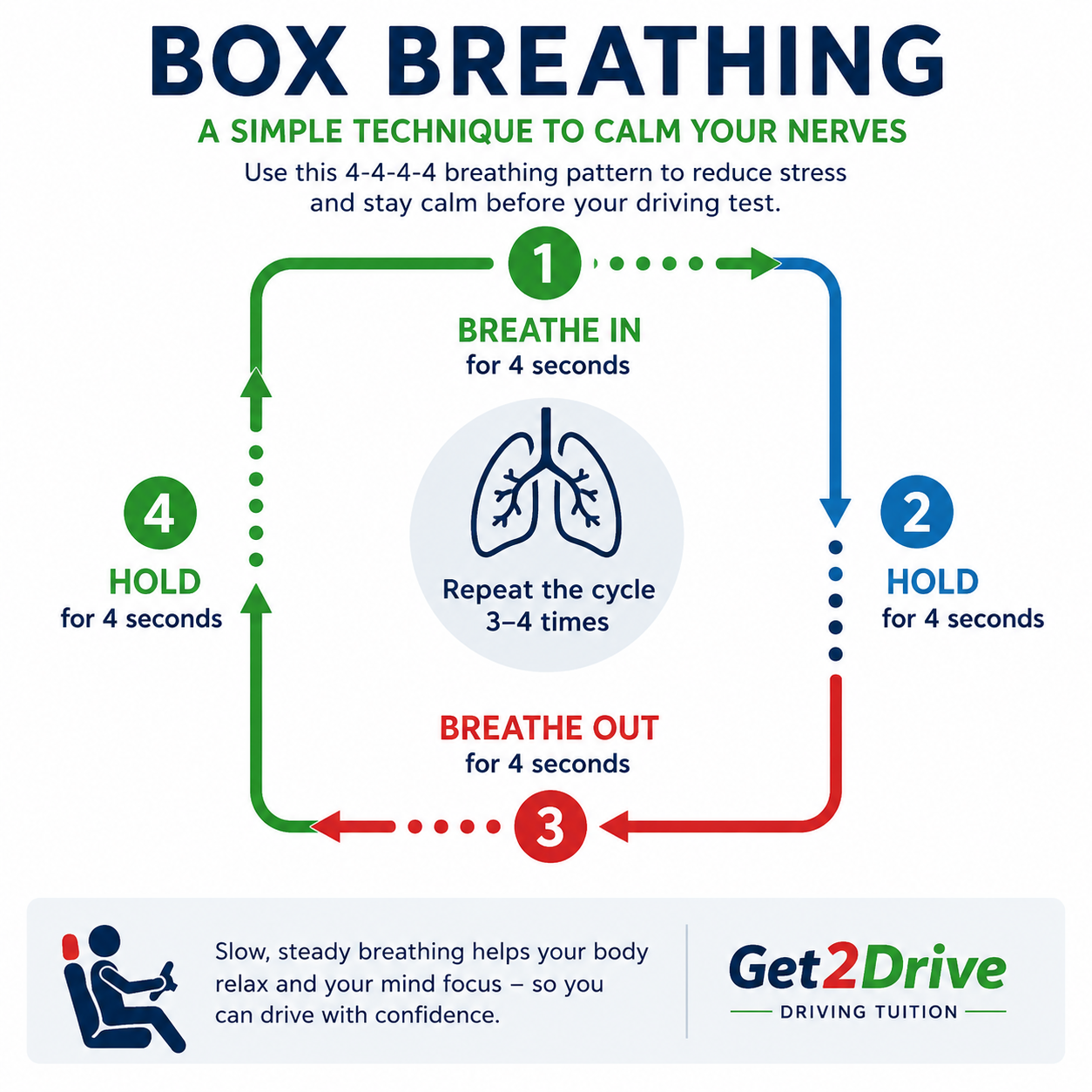
One of the easiest techniques to practise is called box breathing, sometimes known as 4-4-4-4 breathing.
It gets its name because the breathing pattern has four equal stages, like the four sides of a box.
The technique is simple:
- Breathe in gently through your nose for four seconds.
- Hold your breath for four seconds.
- Slowly breathe out for four seconds.
- Hold for four seconds.
- Repeat the cycle three or four times.
Don't force it. If four seconds feels uncomfortable, shorten the count. The important part is slow, controlled breathing rather than hitting an exact number.
According to the Cleveland Clinic, controlled breathing can help move the body away from its "fight or flight" response towards the calmer parasympathetic nervous system.
That makes box breathing particularly interesting for driving test nerves.
When Should You Use Box Breathing?
Don't wait until you're sitting in the test centre to try it for the first time.
Practise it beforehand.
Try a few rounds before a driving lesson. Use it at home when you're relaxed. You want the technique itself to feel familiar so you're not trying to learn something new on test day.
Then, before your driving test, give yourself a couple of minutes to settle.
Feet on the floor.
Shoulders relaxed.
Then:
In: 1, 2, 3, 4.
Hold: 1, 2, 3, 4.
Out: 1, 2, 3, 4.
Hold: 1, 2, 3, 4.
Repeat.
It's discreet, requires no equipment and gives your brain something simple to concentrate on other than:
"What if I fail?"
Once you're actually driving, however, your attention belongs on the road. Don't start counting breathing cycles while negotiating a roundabout!
What Is Thought Field Therapy?
Another technique you may have heard about is Thought Field Therapy, usually shortened to TFT.
TFT was developed by American psychologist Roger Callahan and is one of a group of approaches sometimes referred to as "energy psychology".
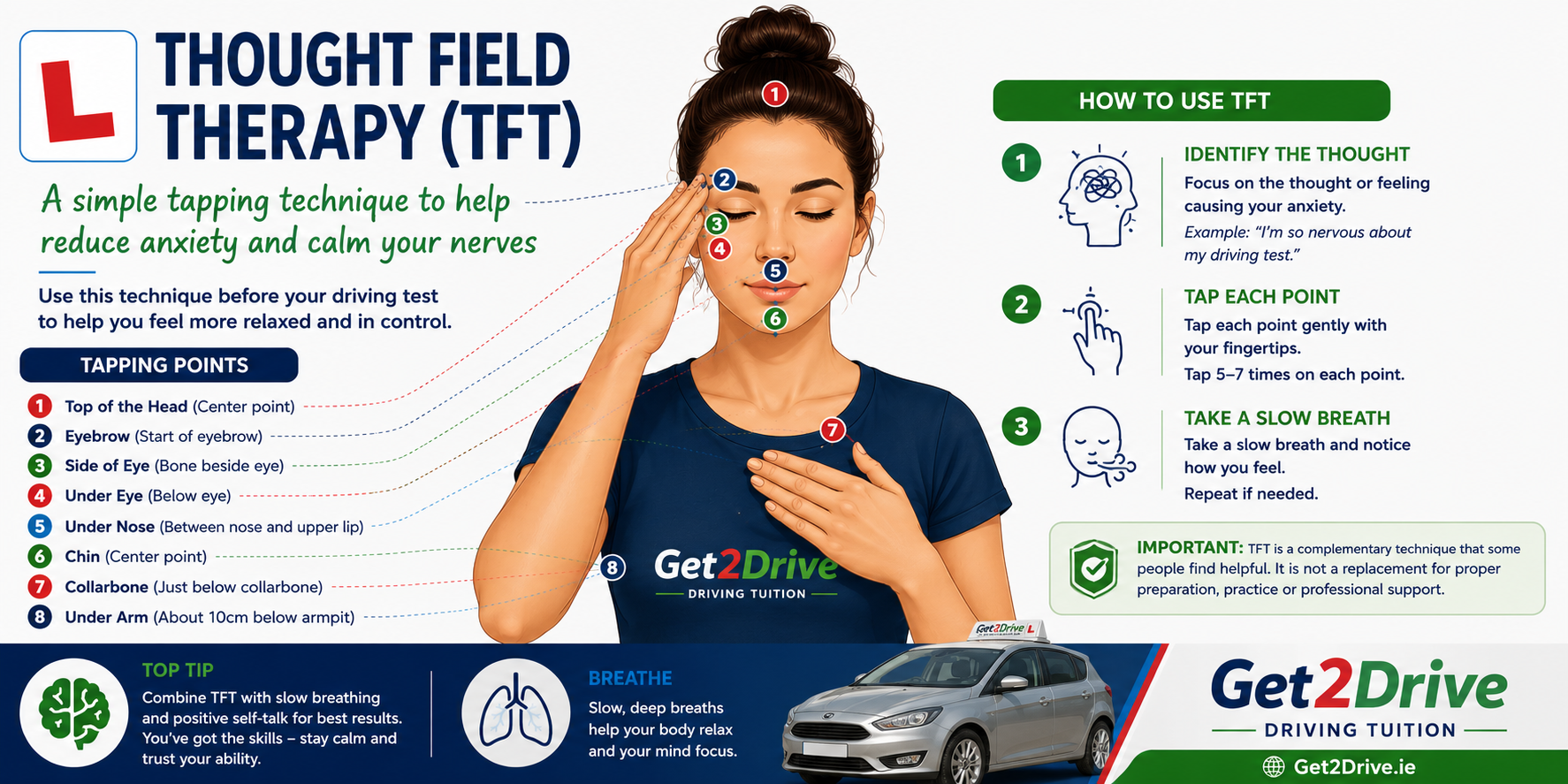
It involves thinking about something causing anxiety while tapping particular points on the body, usually with the fingertips.
The idea behind TFT is that tapping particular points associated with the body's supposed energy meridians can reduce the emotional response connected with a troubling thought.
In our case, that thought might be:
"My driving test is tomorrow and I'm terrified I'm going to fail."
Someone practising TFT might concentrate on that anxiety, rate how strong it feels and then follow a particular sequence of tapping points.
Some people report finding tapping techniques calming.
However, we need to be careful about the claims we make here.
Does Thought Field Therapy Actually Work?
The evidence isn't as clear as it is for controlled breathing.
A small randomised controlled trial involving 45 patients with anxiety disorders reported better outcomes on some anxiety measures for people receiving TFT compared with a waiting-list group. Improvements were also reported at later follow-ups.
Importantly, the researchers themselves acknowledged a significant limitation: the study didn't have the type of active control needed to establish why people improved.
Other scientific reviews have been much more critical of TFT and related "energy psychology" approaches. Critics argue there isn't convincing evidence for the proposed energy-meridian explanation and that benefits could potentially come from other elements of the process, including focused attention, exposure to the anxious thought, relaxation, expectation or interaction with a therapist.
So I'd describe TFT as an optional complementary technique, rather than a proven treatment for driving test anxiety.
If tapping helps you settle your thoughts before a test, that's useful. But I wouldn't rely upon it as a substitute for proper preparation or professional support where anxiety is severe.
Preparation Is Still Your Best Defence Against Test Nerves
No breathing exercise or psychological technique can compensate for simply not being ready.
Confidence needs something to stand on.
Before your driving test you should be comfortable driving independently, dealing with different traffic situations and recovering calmly when something doesn't go exactly to plan.
That last point is particularly important.
You are not expected to produce a perfect drive.
A small mistake doesn't automatically mean you've failed. One of the worst things you can do is decide halfway through your test that something you've done has ruined everything.
It may not have.
Forget it and deal with what's happening now.
If you're unsure about how faults are assessed, my guide to Grade 2 and Grade 3 driving test faults is worth reading before your test.
You can also read my guide explaining what happens during the Irish driving test. Removing some of the mystery around the test can make the whole thing feel considerably less intimidating.
Don't Turn the Days Before Your Test Into a Marathon
There's another mistake I regularly see.
A learner gets a test date and suddenly wants to drive constantly.
Every journey becomes test preparation. Every roundabout gets analysed. Every minor mistake becomes evidence that they're "not ready".
Sometimes more practice is useful.
Sometimes you need to leave your brain alone.
In the final few days, concentrate on maintaining your driving rather than trying to completely rebuild it.
Your instructor isn't expecting you to suddenly become a different driver on test day.
The examiner isn't either.
Look After Yourself the Night Before
There are some boring pieces of advice that remain good advice precisely because they work.
Get a reasonable night's sleep.
Eat something before your test.
Give yourself plenty of time so you're not arriving stressed because you've been rushing.
And be sensible with caffeine. If three coffees normally leave you bouncing off the walls, the morning of your driving test probably isn't the time for a fourth.
If you're using your own vehicle, prepare it in advance rather than discovering something is wrong on the morning of your appointment. I've put together a driving test car checklist covering the things worth checking.
Reducing avoidable stress leaves you with more mental capacity for the thing that actually matters: driving.
Stop Thinking About Passing
This might sound strange coming from a driving instructor, but once the test begins, stop trying to pass it.
You can't control the result directly.
You can control the next decision.
Mirrors.
Position.
Speed.
Observation.
Planning.
Then the next situation.
Then the next.
I've previously explored this idea in my article about The Chimp Paradox and driving test nerves. Under pressure, the emotional part of our thinking can become much louder. Focusing on the process rather than the final result can help prevent that emotional response dominating your driving.
Don't spend 40 minutes trying to pass a driving test.
Spend 40 minutes driving safely.
What If the Nerves Come Back During the Test?
They probably will at some point.
That's OK.
Perhaps you stall.
Perhaps you take longer than you'd like at a junction.
Perhaps the examiner writes something on the tablet and your brain immediately screams:
"WHAT DID I DO?"
Don't chase the thought.
You don't know what they've written and you can't change what happened 30 seconds ago.
Relax your hands.
Drop your shoulders.
Breathe normally.
Look well ahead.
And drive the road in front of you.
The ability to recover from a mistake is itself part of being a good driver.
What If Your Driving Test Anxiety Is More Severe?
There's a difference between ordinary driving test nerves and anxiety that is significantly affecting your life or preventing you from driving.
If you regularly experience panic attacks, severe anxiety or find yourself avoiding driving altogether because of fear, it's worth seeking appropriate professional advice rather than relying solely on self-help techniques.
There's no prize for struggling through it alone.
Your driving instructor should also know if you're particularly anxious. A good instructor can adjust lessons, introduce difficult situations gradually and help distinguish between genuine gaps in your driving skills and anxiety making you doubt skills you already possess.
You may also find my article on understanding anxiety and nerves as a learner driver useful.
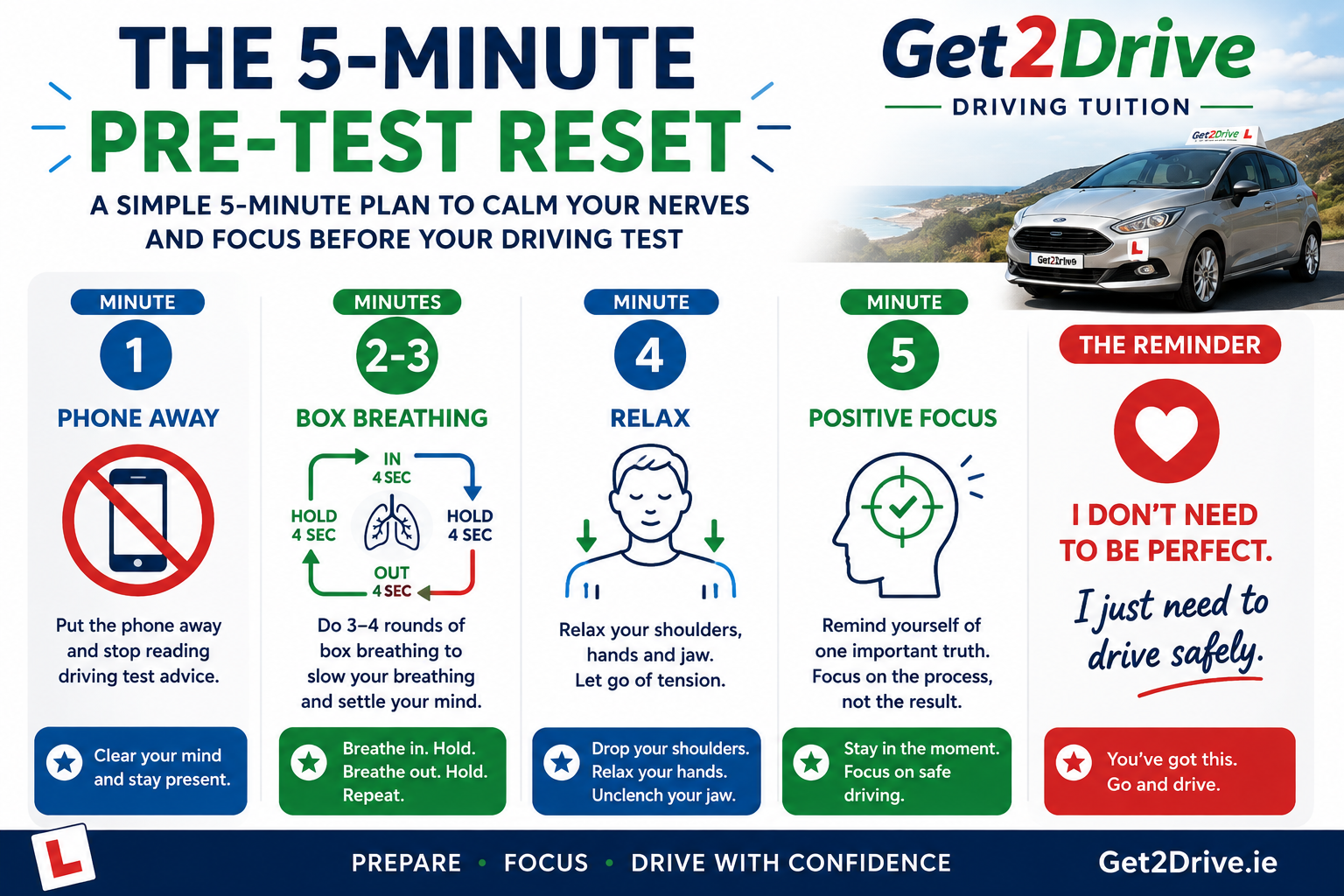
The Five-Minute Pre-Test Reset
If you're sitting outside the test centre and can feel the nerves building, try this:
Minute 1: Put the phone away and stop reading driving-test advice.
Minutes 2-3: Do three or four gentle rounds of box breathing.
Minute 4: Relax your shoulders, hands and jaw.
Minute 5: Remind yourself of one thing:
"I don't need to be perfect. I just need to drive safely."
Then go and drive.
Finally: Nerves Don't Mean You're Not Ready
Some of the most nervous learners I've taught have gone on to produce excellent driving tests.
Equally, some people who appear completely relaxed suddenly feel nervous when the examiner calls their name.
Neither reaction tells us much about their actual driving ability.
Nerves are simply your body's response to something that matters.
Prepare properly. Practise calming techniques before test day. Understand what your body is doing when anxiety appears.
And when the examiner sits beside you, don't try to demonstrate some special version of yourself.
Drive the way you've been taught.
One road, one junction and one decision at a time.